
Server capacity
~7.7 TBless data read per run
This query ran for 53 minutes, made almost 1 billion disk reads and pushed CPU to 70% across 12 threads. Rewriting one NOT IN as NOT EXISTS brought it down to 92 ms.
Data read per run
Source: the post’s before and after measurements. Data = 942,222,862 → 30,312 page reads × 8 KB.
Most SQL Servers bottleneck on Disk, which is number of disk operations required to pull all data necessary to process the query.
When tuning, the goal is often to get SQL Server to read less data from the disk.
The problem
We identified a long-running query that was pushing CPU usage to 70% and concurrently executing across 12 threads.
Here’s a glance at the pre-tuning metrics:
- Duration (query duration in milliseconds): 3,200,290
- Disk (number of read operations required to get all data needed): 942,222,862
The query execution time was 53 minutes (3,200,290 ms) while making almost 1 billion disk read operations.
The fix
- After reviewing the query plan, we identified the culprit: a
NOT INoperation invoking aVIEW. - The fix was straightforward: switching the
NOT INoperation to aNOT EXISTSoperation. See below.
Here is how we modified the original query to fix the problem:

Note: The performance difference between NOT IN and NOT EXISTS is often massive. This is one of those examples.
Final thoughts
Swapping the
NOT INoperation for aNOT EXISTSoperation resulted in a 34,785x improvement.
In SQL performance tuning, it helps to understand how the SQL engine retrieves data.
Under the hood
Before and after, every measurement
Small changes, huge difference? Totally!
We slashed a query's run time from 3,200,290 ms (53 minutes) down to 92 ms. No joke!
Below is a comparison of the number of disk reads before vs after tuning:
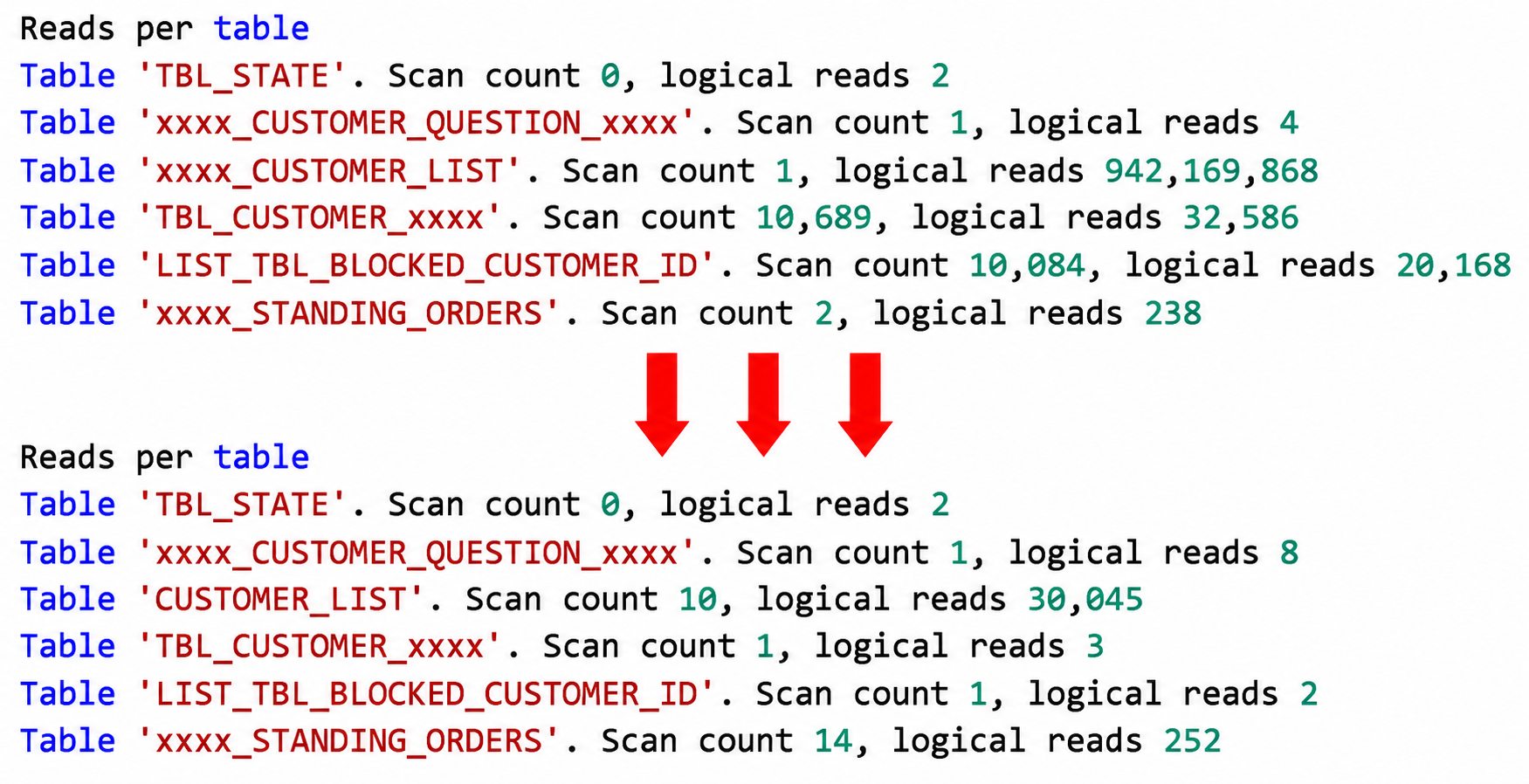
| Before | After | Improvement | |
|---|---|---|---|
| Duration (ms) | 3,200,290 | 92 | 34,785x |
| Disk (number of reads) | 942,222,862 | 30,312 | 31,084x |
A query rewrite reduced the duration of the query by 34,785 times.